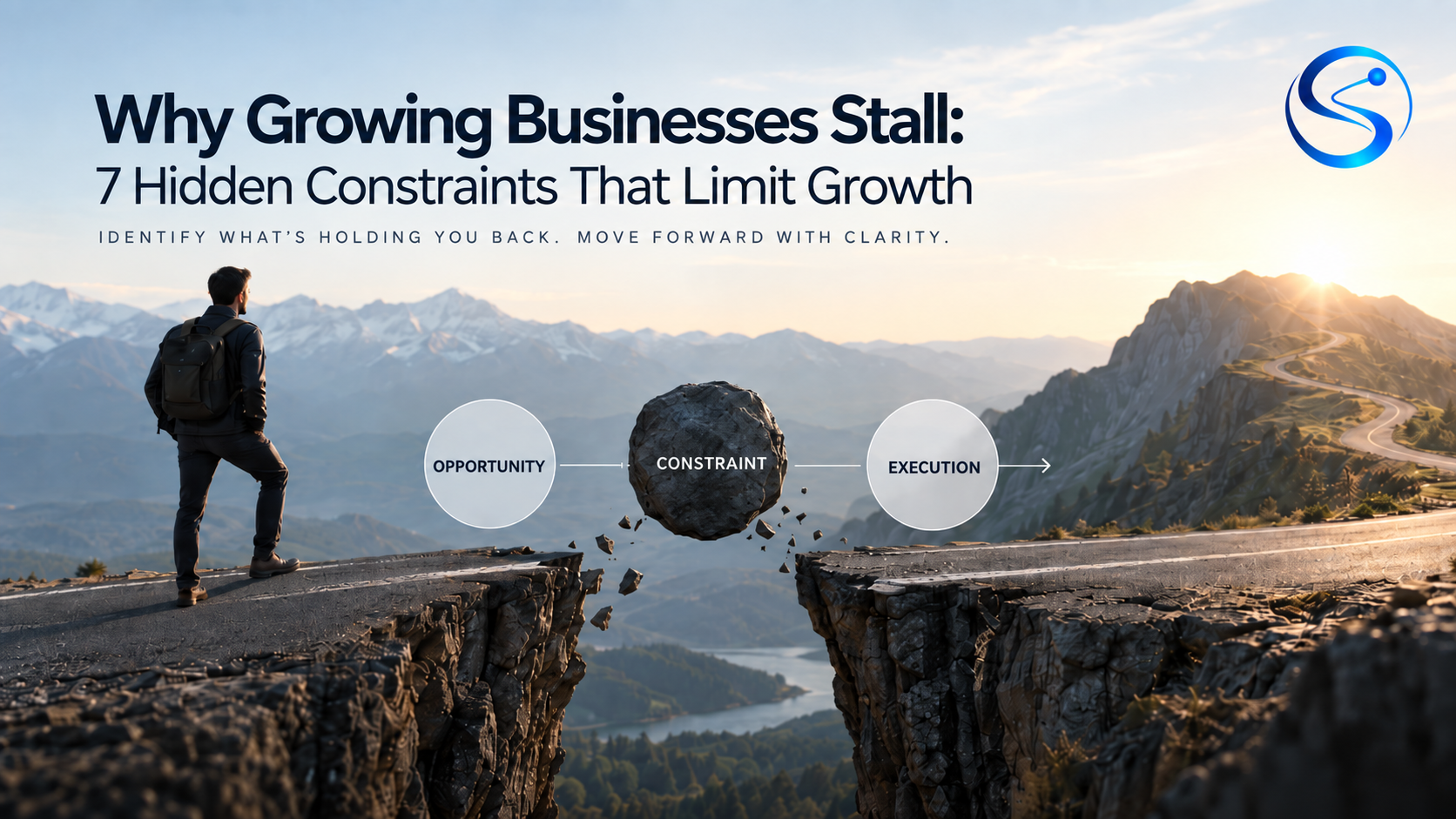
What causes a growing business to stall?
A growing business can stall when a constraint develops between opportunity and execution.
Common causes include:
unclear growth priorities
outdated market assumptions
weak commercial conversion
excessive dependency on key people
unrepeatable processes
poor decision intelligence
slow execution
The visible problem is not always the real constraint.
A company may think it needs more leads when the real issue is poor conversion.
It may think it needs more staff when the real issue is an inefficient process.
It may think it needs a new strategy when the real issue is execution.
This is why one of the most important growth questions a business can ask is:
What is currently limiting the next stage of growth?
What is a growth constraint?
A growth constraint is the factor currently limiting a business's ability to convert opportunity into sustainable commercial results.
The constraint itself may not always be invisible.
What is often hidden is how much it is limiting growth.
At Saiah Digital, we think about this through a simple framework:
Opportunity → Constraint → Execution
A business identifies an opportunity.
It makes a decision.
It builds the systems and processes required to pursue that opportunity.
Then it executes.
If a constraint develops anywhere along that path, growth can slow.
The objective is not to fix everything at once.
It is to identify the constraint having the greatest impact on growth and address it first.
1. The business does not know which growth opportunity deserves priority
Growth creates options.
A business may be considering:
new customer segments
new geographic markets
additional services
partnerships
new digital channels
pricing changes
adjacent revenue streams
More opportunity is not always the same as more growth.
Without a disciplined way to compare opportunities, the business can spread its attention across too many initiatives.
Marketing targets multiple audiences.
Sales pursues several customer profiles.
Leadership introduces competing priorities.
Teams work on projects that have never been properly ranked.
The result is activity without enough commercial focus.
The underlying constraint is not a lack of opportunity.
It is a lack of opportunity prioritization.
A stronger approach is to compare opportunities against factors such as:
market demand + commercial value + customer fit + competitive position + execution capability
Question to ask
If we could only pursue one growth opportunity over the next six months, which one would create the greatest commercial impact?
If the answer is unclear, prioritization may already be limiting growth.
2. The market has changed faster than the business has
Every business operates on assumptions.
Who the customer is.
What customers value.
How they buy.
What competitors are doing.
What people are willing to pay.
Which channels generate demand.
Those assumptions may have been correct when the current strategy was developed.
But markets change.
Customer behaviour shifts.
Competitors reposition.
Technology alters buying patterns.
New entrants appear.
Pricing models evolve.
AI changes how customers discover, compare and interact with businesses.
A company can continue executing reasonably well while gradually becoming less aligned with the market around it.
Nothing appears obviously broken.
The business simply becomes less effective over time.
This is where market intelligence matters.
Market research often answers a question at a particular point in time.
Market intelligence helps a business continuously understand:
what is changing
why it matters
where demand is emerging
where competitive pressure is increasing
what action should follow
Question to ask
What do we currently believe about our market that we have not properly validated in the last 12 months?
Outdated assumptions can quietly become growth constraints.
3. Commercial activity is not converting into enough revenue
A business can be extremely busy without being commercially efficient.
More traffic.
More enquiries.
More meetings.
More proposals.
More leads.
More activity can disguise a weak commercial system for a surprisingly long time.
The real issue may be conversion.
Consider a simple commercial journey:
attention → interest → enquiry → conversation → proposal → customer
Every transition matters.
A company can generate strong activity at the top while losing too much value further down.
The constraint may be:
poor lead quality
unclear positioning
slow response times
weak follow-up
inconsistent qualification
low proposal conversion
pricing friction
an unclear value proposition
lack of trust
This is why “we need more leads” is not always the right diagnosis.
If the commercial system is leaking, more leads simply create more leakage.
Sometimes the fastest route to growth is not generating more demand.
It is converting more of the demand the business already has.
Question to ask
At which stage of our commercial process do the most promising opportunities disappear?
That stage may be the real constraint.
4. Too much growth depends on specific people
Early-stage growth often depends heavily on individual effort.
The founder remembers every important customer.
A salesperson manages follow-up manually.
One employee understands the full operational process.
A manager knows which issues need attention without needing a dashboard.
At smaller scale, this can work.
As the business grows, it becomes fragile.
If one person becomes overloaded, the process slows.
If they are unavailable, work is delayed.
If they leave, knowledge leaves with them.
Growth begins depending on heroic effort instead of repeatable capability.
The objective is not to remove people from the process.
It is to move recurring work from:
memory → process → system → visibility
That creates more organizational capacity and allows people to focus on judgment, relationships and higher-value decisions.
Question to ask
Which important part of our growth process would struggle if one key person was unavailable for two weeks?
That answer can expose where dependency is limiting scale.
5. The business is trying to scale what has not become repeatable
Scale magnifies whatever already exists.
If the sales process is strong, scale can increase revenue.
If onboarding is efficient, scale can increase customer capacity.
If delivery is consistent, scale can improve margins.
But the opposite is also true.
If the process is inconsistent, scale increases inconsistency.
If follow-up is weak, more leads create more missed opportunities.
If delivery is inefficient, more customers create more operational pressure.
If ownership is unclear, a larger team creates more confusion.
A useful principle is:
Scaling inefficiency does not create efficiency. It creates larger inefficiency.
Before increasing volume, businesses need to identify which parts of the operating and commercial model must become repeatable.
This may include:
lead qualification
proposals
sales follow-up
onboarding
service delivery
reporting
customer support
account management
Standardization does not mean bureaucracy.
It means creating enough consistency that growth does not require the business to reinvent the process every time.
Question to ask
Which process would become painful if customer volume doubled next month?
That process may need to be strengthened before further scaling.
6. The business has information but not decision intelligence
Most growing businesses already generate plenty of data.
CRM records.
Sales reports.
Website analytics.
Financial information.
Customer feedback.
Advertising performance.
Operational metrics.
Support tickets.
The problem is rarely a complete lack of information.
The problem is often that the information does not reliably answer:
What should we do next?
There is a difference between data, insight and decision intelligence.
Knowing that sales declined is data.
Understanding where and why they declined is insight.
Knowing what commercial action should follow is decision intelligence.
That progression matters because information only creates commercial value when it improves decisions.
AI can strengthen this process by helping businesses:
analyse patterns
compare opportunities
summarize large volumes of information
surface anomalies
identify trends faster
accelerate decision-making
But AI only becomes commercially useful when it is connected to a real business question.
Question to ask
What important decision could we make better if the information we already collect was analysed differently?
There may be unrealized commercial value already sitting inside the business.
7. Execution cannot keep pace with opportunity
This may be the most important constraint of all.
Many businesses already know what they should be doing.
The opportunity has been identified.
The strategy makes sense.
Management agrees.
And then execution slows.
Projects compete for attention.
Ownership becomes unclear.
Meetings produce decisions without enough follow-through.
Operational issues displace growth initiatives.
Technology implementations remain unfinished.
Commercial opportunities remain underdeveloped.
Good ideas become permanent agenda items.
The business develops a gap between knowing and doing.
That gap becomes more expensive as the business grows.
Opportunities have a shelf life.
Competitors move.
Customers change.
Markets develop.
The business that executes earlier often captures the advantage.
A commercially useful growth strategy therefore needs to connect:
opportunity → decision → priority → ownership → execution → measurement
Question to ask
Which high-value initiative have we known we should execute for months but still have not completed?
That answer may reveal more about the company’s growth constraint than another planning session.
The visible problem is not always the real constraint
Growth problems are often misdiagnosed.
A business sees falling sales and assumes it needs more marketing.
The actual issue is poor conversion.
A company sees operational pressure and assumes it needs more staff.
The actual issue is an inefficient process.
A business struggles to expand and assumes the market is too competitive.
The actual issue is weak positioning.
A company introduces new technology but sees little improvement.
The actual issue is that the underlying process was never redesigned.
This is why adding resources is not always the right first move.
The better sequence is:
identify the constraint → address the constraint → reassess
Once one constraint is removed, another may become the next limiting factor.
That is normal.
Growth is an ongoing process of identifying what is limiting progress and improving the system around it.
The Saiah Digital Growth Constraint Check
If growth has slowed, start with these seven questions.
1. Direction
Do we know which growth opportunity deserves the most attention?
2. Market alignment
Are the assumptions behind our strategy still current?
3. Conversion
Where are we losing commercial momentum?
4. Dependency
Which important processes rely too heavily on specific people?
5. Repeatability
What are we trying to scale before making it repeatable?
6. Intelligence
Are we turning information into better commercial decisions?
7. Execution
Where is execution falling behind opportunity?
The goal is not to answer every question perfectly.
It is to identify the question where the answer creates the greatest concern.
That may be where the constraint is hiding.
Frequently asked questions
Why do growing businesses suddenly stall?
Growing businesses often stall because one part of the commercial or operating system can no longer support the next stage of growth. The constraint may exist in strategy, conversion, processes, market alignment, decision-making or execution.
How do you identify a business growth constraint?
Start by looking for the area where opportunity is being lost, delayed or underutilized. Compare growth priorities, market assumptions, conversion performance, key-person dependencies, repeatability, use of data and execution speed.
Is slow growth always a sales or marketing problem?
No. Slow growth can result from poor conversion, weak positioning, inefficient operations, outdated market assumptions, unclear priorities or execution problems. Increasing marketing may add activity without solving the underlying issue.
Can technology solve growth constraints?
Technology can help when the underlying process and business objective are clear. Automating an inefficient or poorly designed process can simply make the inefficiency happen faster.
How can AI help a growing business?
AI can help businesses analyse information, identify patterns, compare opportunities, improve research and accelerate decision-making. Its value is greatest when it is applied to a specific commercial problem rather than used as a standalone tool.
Growth does not always require more
When growth slows, the instinct is often to add something.
More marketing.
More salespeople.
More software.
More products.
More activity.
But sometimes the next stage of growth starts somewhere else.
With identifying the constraint already preventing the business from moving faster.
Then removing it.
Then building from there.
Because the next stage of growth is not always waiting behind another opportunity.
Sometimes it is waiting behind the constraint preventing the business from executing on the opportunities it already has.