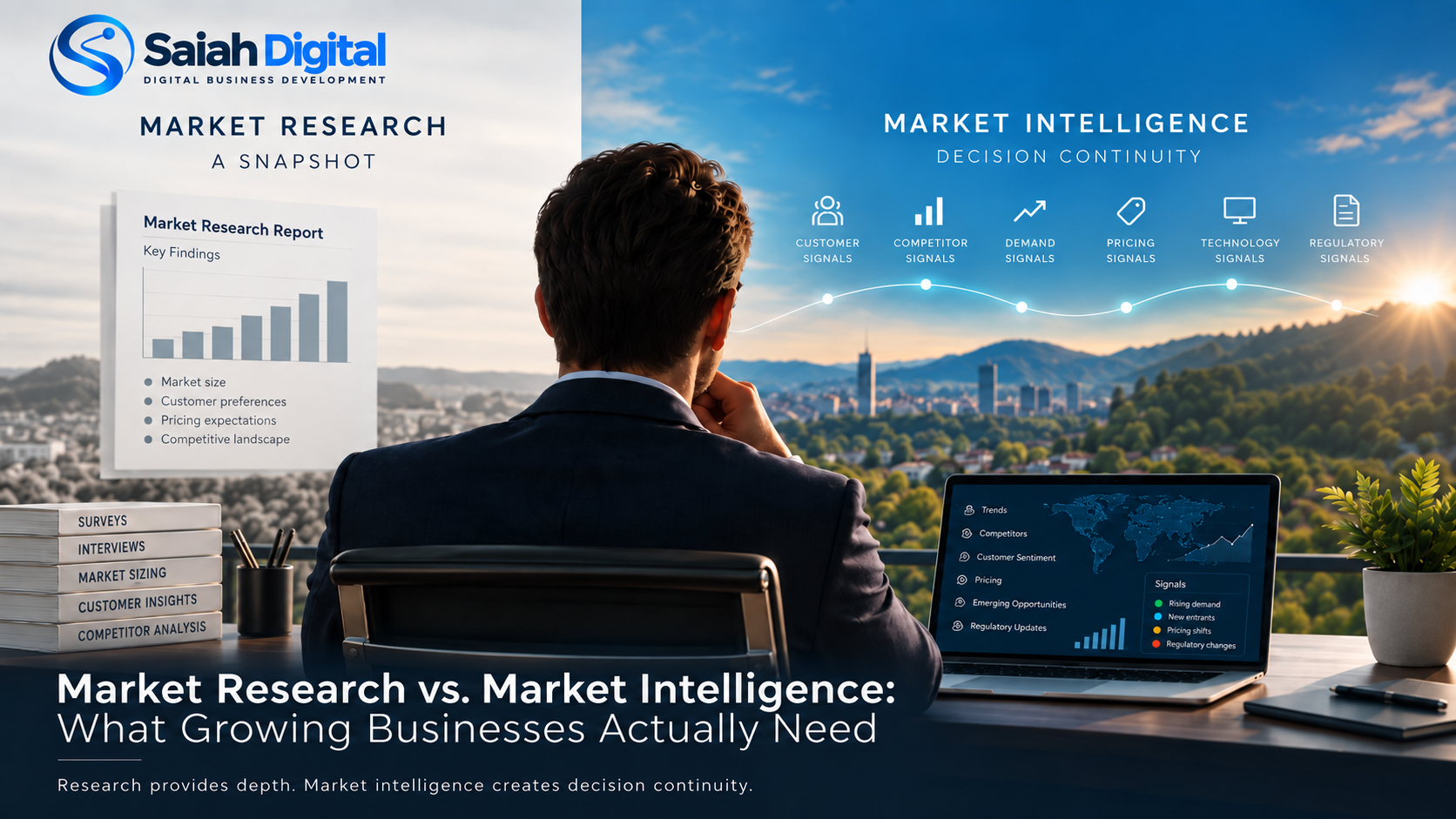
Research is a snapshot. Intelligence creates decision continuity.
A research report can tell you what the market looked like when the research was done.
Market intelligence helps you keep making decisions after the market moves.
That distinction matters because growing businesses operate in environments that rarely stay still.
Customer expectations change.
Competitors reposition.
Pricing shifts.
New technology changes what is possible.
New regulations appear.
Demand moves between segments.
The problem is not usually that businesses lack information.
It is that information can become outdated faster than decisions do.
That is why growing businesses need both market research and market intelligence.
They are related, but they solve different problems.
A simple way to think about it is:
Market research investigates a question.
Market intelligence creates decision continuity.
At Saiah Digital, we think about market intelligence as a continuous loop:
Collect → Interpret → Prioritize → Act → Monitor
The goal is not simply to know more.
It is to keep decisions aligned with what is changing.
What is market research?
Market research is the structured collection and analysis of information to answer a defined business question.
It may include:
customer interviews
surveys
focus groups
pricing studies
market sizing
competitor studies
product testing
demand validation
customer segmentation
Market research is especially useful when a business needs depth around a specific decision.
For example:
Should we launch this service?
Which customer segment should we target?
What price will the market accept?
Is there enough demand in this market?
How do customers perceive our offer?
These are defined questions.
Research helps reduce uncertainty around them.
What is market intelligence?
Market intelligence is the ongoing process of collecting, interpreting, and applying information about customers, competitors, demand, pricing, technology, regulation, and market conditions to support commercial decisions.
It is not simply a report.
It is an operating capability.
Market intelligence helps a business continually answer:
what changed
why it matters
where opportunity is emerging
where risk is increasing
what assumptions need updating
what action should follow
That is the difference between static information and decision continuity.
What is the simplest difference between market research and market intelligence?
Market research investigates a defined question.
Market intelligence continuously updates the business's understanding so decisions can adapt as conditions change.
Research gives depth.
Intelligence gives continuity.
The strongest growing businesses use both.
The biggest difference is timing
Market research is often project-based.
Market intelligence is continuous.
A research project may begin and end.
An intelligence system keeps watching.
That matters because business decisions are often built on assumptions.
For example:
Who is our best customer?
What do they value?
How sensitive are they to price?
Which competitor matters most?
Which market is growing?
Which channel is strongest?
Those assumptions may have been correct when they were made.
They may not still be correct today.
Question to ask
Which important decisions in our business depend on assumptions we have not recently validated?
That is often where market intelligence begins to create value.
Market research tells you what is true now
Market intelligence helps you see what is changing.
Research may tell you:
Customers currently value speed over price.
Intelligence may show:
That preference is changing because competitors now offer both.
Research may tell you:
This market is growing.
Intelligence may show:
Growth is slowing in one segment and accelerating in another.
Research may tell you:
Competitor A is the market leader.
Intelligence may show:
Competitor B is gaining momentum through a new channel.
The difference is not simply more information.
It is the ability to detect movement.
The six signal streams growing businesses should monitor
A useful market intelligence system does not need to monitor everything.
It needs to monitor the information most likely to affect commercial decisions.
At Saiah Digital, we think of these as signal streams.
1. Customer signals
Look for:
changing needs
recurring complaints
feature requests
buying behaviour
churn reasons
pricing sensitivity
customer sentiment
changes in usage
Customers often signal a market shift before it appears in industry reports.
2. Competitor signals
Monitor:
new products
pricing changes
partnerships
hiring patterns
market expansion
messaging shifts
technology adoption
distribution changes
Competitor activity can reveal where they believe future demand will emerge.
3. Demand signals
Watch:
enquiry patterns
sales trends
search behaviour
category growth
new customer segments
regional demand
buying intent
repeated customer requests
Demand signals help identify where commercial momentum is building or weakening.
4. Pricing signals
Track:
competitor pricing
discounting
package changes
customer price resistance
premium positioning
margin pressure
changes in perceived value
Pricing can often move before broader market changes become obvious.
5. Technology signals
Monitor:
new platforms
AI capabilities
automation
cost reductions
new infrastructure
digital distribution
emerging business models
Technology can create opportunities by changing what is commercially possible.
6. Regulatory signals
Track:
new legislation
compliance requirements
licensing
tax changes
import rules
consumer protections
sector-specific regulation
Regulation can create both risk and new market openings.
Monitoring is not the same as intelligence
This distinction is important.
A business can track competitors, pricing, news, and customer feedback and still not have market intelligence.
Why?
Because monitoring only tells you that something changed.
Monitoring tells you what changed.
Intelligence tells you what the change means and what to do about it.
For example:
Monitoring tells you a competitor reduced prices.
Intelligence asks:
why did they do it?
is this temporary or structural?
which customers will care?
does our positioning still hold?
should we respond?
what happens if we do nothing?
That is where information becomes commercially useful.
The Saiah Market Intelligence Loop
Market intelligence only creates value when it leads to better action.
That is why we use a five-stage loop.
1. Collect
Gather information from:
customers
competitors
internal sales data
market reports
digital channels
public sources
regulatory updates
technology developments
The goal is not to collect everything.
It is to collect what is relevant to the decisions the business needs to make.
2. Interpret
Raw information is not intelligence.
Interpretation asks:
what changed?
why did it change?
is it temporary or structural?
who does it affect?
what does it mean commercially?
This is where information becomes insight.
3. Prioritize
Not every signal matters.
Leadership needs to distinguish:
what is urgent
what creates opportunity
what creates risk
what needs validation
what can be ignored
This prevents the business from reacting to noise.
4. Act
Intelligence should influence decisions.
That may mean:
changing pricing
repositioning an offer
targeting a new segment
delaying an investment
testing a new channel
responding to a competitor
changing sales priorities
entering or avoiding a market
If intelligence does not influence action, it is simply information.
5. Monitor
After action is taken, keep watching.
Did the assumption hold?
Did customers respond?
Did competitors react?
Did the market continue moving?
This is what turns market intelligence into a loop rather than a report.
What decisions should market intelligence actually change?
A useful intelligence system should influence real commercial decisions.
That may include:
pricing
positioning
customer targeting
market expansion
product or service development
channel strategy
investment timing
sales priorities
partnerships
technology adoption
The objective is not to create a larger information library.
It is to improve the quality and timing of decisions.
When should a business use market research?
Market research is usually strongest when the business has a defined question.
Examples include:
launching a new service
entering a new market
testing pricing
validating demand
understanding a customer segment
measuring brand perception
It has a clear scope.
It should produce a clear answer or recommendation.
When should a business use market intelligence?
Market intelligence is strongest when the decision environment is continuously changing.
Examples include:
competitor monitoring
pricing strategy
market expansion
customer retention
growth planning
product direction
commercial prioritization
technology adoption
It becomes part of the business's operating rhythm.
Growing businesses usually need both
Market research and market intelligence are not substitutes.
They complement each other.
Research gives depth.
Intelligence gives continuity.
Research can answer:
Should we enter this market?
Intelligence helps answer:
Is the market still attractive after we enter?
Research can answer:
What does this customer segment want?
Intelligence helps answer:
How are those preferences changing?
Research can answer:
What price will customers accept today?
Intelligence helps answer:
How is pricing pressure evolving?
The strongest businesses use research to investigate important questions and intelligence to keep their assumptions current.
A practical market intelligence cadence for growing businesses
Market intelligence does not need to become a large corporate function.
A lightweight operating rhythm is often enough.
Weekly
Review:
important competitor moves
major industry developments
regulatory changes
significant technology updates
urgent market signals
The goal is awareness, not deep analysis.
Monthly
Review:
customer feedback
lost sales
pricing changes
demand trends
sales performance
competitor activity
emerging opportunities
The goal is to identify patterns rather than isolated events.
Quarterly
Conduct a strategic market review.
Ask:
what has materially changed?
which assumptions need updating?
what new opportunities are emerging?
what risks are increasing?
what should we do differently next quarter?
This is where intelligence feeds strategy.
AI can make market intelligence more practical
Historically, continuous market intelligence could require significant manual effort.
AI changes that.
It can help businesses:
summarize competitor updates
analyse customer feedback
compare pricing
monitor news
organize market signals
classify information
detect patterns
identify anomalies
produce recurring intelligence summaries
This makes continuous intelligence more accessible to smaller businesses.
But AI does not remove the need for judgment.
Poor source selection can create faster noise rather than better intelligence.
The most important question remains:
What does this information mean for the business?
AI can accelerate collection and synthesis.
People still need to determine commercial significance.
The risk of relying only on research
Research becomes dangerous when businesses treat a conclusion as permanently true.
A report can become a static snapshot.
Markets are not static.
The customer segment changes.
The competitive landscape changes.
Technology changes.
Pricing changes.
The economics change.
If leadership continues operating from old assumptions, the business can slowly become misaligned with the market.
That is why decision continuity matters.
Market intelligence helps the business move from:
What did we learn?
to:
What is changing now, and what should we do about it?
Frequently asked questions
What is the difference between market research and market intelligence?
Market research is usually a focused project designed to answer a specific question. Market intelligence is an ongoing process that monitors change and supports continuous commercial decision-making.
Which is better: market research or market intelligence?
Neither is universally better. Research is stronger for deep investigation of a defined question. Market intelligence is stronger for keeping decisions current as market conditions change.
Do small businesses need market intelligence?
Yes. Small and growing businesses can benefit significantly from lightweight market intelligence because they often need to respond quickly to changing demand, competitors, pricing, and customer behaviour.
What are examples of market intelligence?
Examples include customer sentiment, competitor activity, demand patterns, pricing changes, technology shifts, regulatory developments, and market-expansion activity.
What is the difference between market monitoring and market intelligence?
Monitoring tells you what changed. Market intelligence interprets why the change matters and what action the business should consider.
Can AI be used for market intelligence?
Yes. AI can help collect, organize, summarize, and analyse large amounts of market information. Human judgment is still required to determine whether the information is reliable and commercially relevant.
How often should market intelligence be updated?
It depends on the speed of the market. Important developments may need weekly monitoring, broader commercial reviews may happen monthly, and strategic assessments may happen quarterly.
Research answers questions. Intelligence keeps decisions current.
That is the simplest distinction.
Market research helps a business investigate an important issue.
Market intelligence helps the business continue learning after the research is finished.
For growing businesses, that continuity matters.
Because the market does not stop changing just because the research project is complete.
The businesses that adapt faster are often the businesses that see change earlier, interpret it correctly, and act before the opportunity or risk becomes obvious.