Most businesses do not have an opportunity shortage
They have a prioritization problem.
A growing business may already be considering:
new customer segments
new markets
additional services
strategic partnerships
new digital channels
pricing changes
adjacent revenue streams
new technology-enabled offers
The challenge is rarely finding another possibility.
The challenge is deciding which possibility is strong enough to become a real growth priority.
That distinction matters.
Because every new initiative consumes:
capital
management attention
team capacity
sales effort
technology resources
time
An attractive idea is not automatically a good opportunity.
And a good opportunity is not automatically the right opportunity for your business right now.
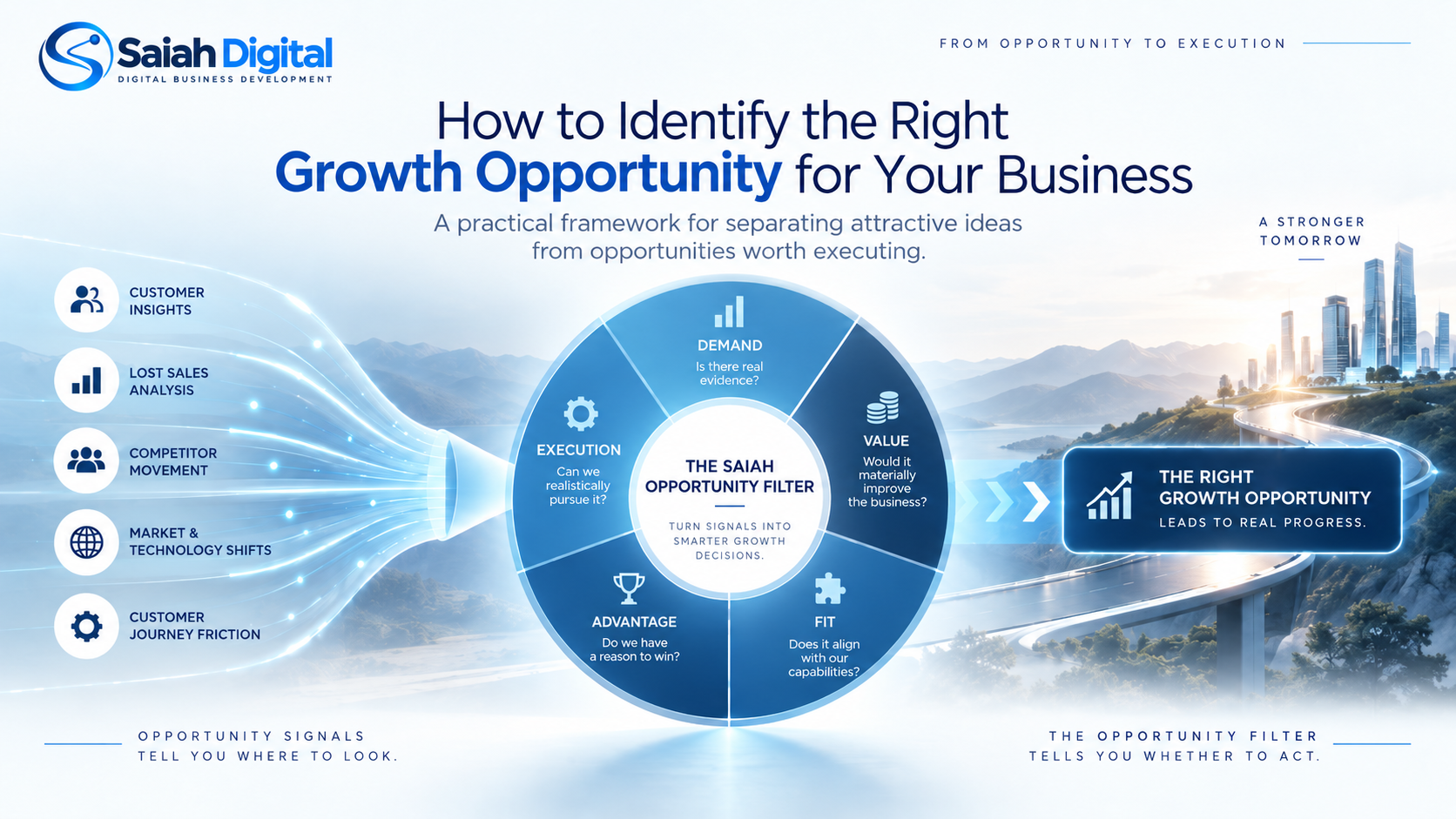
At Saiah Digital, we separate opportunity identification into two stages:
Signal → Opportunity
First, identify signals that suggest something commercially interesting may be happening.
Then determine whether that signal represents an opportunity worth acting on.
A signal tells you where to look.
The opportunity evaluation tells you whether to act.
What is a growth opportunity?
A growth opportunity is a commercially viable path to increased revenue, customer value, market position, or strategic advantage that the business has a realistic ability to pursue.
That last part matters.
A market may be attractive.
Demand may be growing.
Competitors may be entering.
Technology may be opening new possibilities.
But unless the business has a credible path to capture value, the opportunity may still be premature, poorly aligned, or too expensive to pursue.
This is where disciplined opportunity intelligence becomes useful.
Where do growth opportunities come from?
Growth opportunities rarely appear without warning.
They usually emerge through observable opportunity signals.
These signals can come from inside the business, outside the business, or from changes in the wider market.
1. Existing customers
Your current customers are often one of the strongest sources of opportunity intelligence.
Look for:
repeated requests
unmet needs
recurring complaints
complementary purchases
usage patterns
high-value customer segments
reasons customers leave
workarounds customers have created for themselves
When several customers repeatedly ask for something similar, that may be more than a service issue.
It may be a commercial signal.
Signal question
What are customers repeatedly asking for that we do not currently provide well?
2. Lost sales
Lost deals are not only missed revenue.
They are market intelligence.
Review:
why prospects chose competitors
which requirements could not be met
where price became a problem
which objections appear repeatedly
what buyers expected but did not find
which prospects almost converted
Patterns in lost sales can reveal:
positioning gaps
unmet demand
missing capabilities
pricing problems
product opportunities
Signal question
What reason for losing business appears often enough that it deserves strategic attention?
3. Competitor movement
Competitors often reveal where the market may be moving.
Watch for:
new services
new pricing
geographic expansion
partnerships
hiring patterns
technology adoption
customer-segment changes
acquisitions
repositioning
The objective is not to copy competitors.
It is to interpret what their activity may be signalling about demand, economics, or market direction.
Signal question
What recent competitor move might indicate a change in customer demand or market attractiveness?
4. Market, regulatory, and technology change
Some of the strongest opportunities are created when external conditions change.
For example:
new regulations
demographic shifts
changes in customer behaviour
new distribution channels
lower technology costs
new payment methods
AI capabilities
changing import or trade conditions
new infrastructure
Technology can be especially important because it changes what is economically possible.
The useful question is not simply:
How can we use AI?
It is:
What previously expensive, slow, or difficult activity has become easier because of AI?
That may create entirely new commercial models.
Signal question
What has recently become possible, cheaper, faster, or more accessible in our market?
5. Friction in the customer journey
Where customers repeatedly experience friction, opportunity often exists.
Look for:
slow processes
poor access
confusing buying journeys
long response times
manual workflows
fragmented service
limited transparency
poor handoffs
inconvenient payment or onboarding
Businesses frequently create value not by inventing something entirely new, but by making an existing experience significantly better.
Signal question
Where do customers consistently lose time, effort, confidence, or money?
A signal is not yet an opportunity
This is where many businesses make a mistake.
A customer request is a signal.
A competitor launch is a signal.
A technology shift is a signal.
Rising search demand is a signal.
A new regulation is a signal.
None of those, by themselves, prove that the business should act.
A signal becomes a meaningful growth opportunity only after it has been commercially evaluated.
That is where the Saiah Opportunity Filter comes in.
The Saiah Opportunity Filter
We evaluate opportunities across five dimensions:
Demand → Value → Fit → Advantage → Execution
A strong opportunity should perform well across all five.
1. Demand: Is there real evidence that customers want this?
Opportunity starts with demand.
But demand should be validated, not assumed.
Useful evidence may include:
customer requests
buying behaviour
search demand
competitor growth
repeated pain points
willingness to pay
recurring workaround behaviour
market growth
The strongest opportunities usually exist where customers are already spending money, time, or effort trying to solve a problem.
Question to ask
What evidence tells us this demand is real rather than hypothetical?
2. Value: Would success materially improve the business?
Not every problem is commercially important enough to pursue.
The opportunity should have a credible path to value.
That may include:
revenue growth
margin improvement
stronger retention
higher customer lifetime value
cross-sell potential
lower acquisition cost
strategic positioning
recurring revenue
access to a larger market
The important question is not:
Can we sell this?
It is:
If we succeed, does this materially improve the business?
Question to ask
What measurable commercial result would this opportunity create if executed well?
3. Fit: Is this a good opportunity for our business?
A market can be attractive without being attractive for you.
A business should consider whether the opportunity aligns with:
existing customers
brand positioning
internal capabilities
operating model
distribution
technology
team expertise
capital availability
strategic direction
The strongest opportunities often sit close enough to existing capabilities that the business can leverage what it already knows.
Question to ask
What do we already have that makes this opportunity easier for us to pursue than for an average entrant?
4. Advantage: Is there a credible reason we can win?
Demand alone does not create advantage.
If an opportunity is attractive, other businesses may see it too.
The question becomes:
Why would customers choose us?
Potential sources of advantage include:
specialized expertise
speed
relationships
trust
distribution
local knowledge
better technology
pricing
customer experience
proprietary data
stronger service delivery
a differentiated business model
The advantage does not need to last forever.
But it should be strong enough to create a credible path into the market.
Question to ask
What gives us a realistic reason to win against the alternatives already available?
5. Execution: Can the business realistically pursue it now?
This is where many attractive opportunities fail.
The market looks good.
Demand is real.
The economics make sense.
But the business underestimates execution requirements.
Pursuing the opportunity may require:
new skills
additional capital
technology
regulatory knowledge
sales capability
operational capacity
partnerships
customer support
new processes
management attention
Execution readiness is not binary.
An opportunity may be:
Ready now The business can move with existing capabilities.
Ready with minor gaps Small capability improvements are required.
Ready after investment The opportunity is attractive, but meaningful preparation is needed.
Strategically interesting but premature The opportunity may matter later, but should not be prioritized now.
Question to ask
What would need to be true inside the business for this opportunity to succeed?
The biggest market is not always the best opportunity
Businesses are naturally attracted to:
the largest market
the newest technology
the fastest-growing sector
the biggest customer segment
But the largest opportunity on paper is not always the strongest commercial decision.
A smaller opportunity may have:
stronger customer fit
better margins
lower acquisition costs
weaker competition
faster execution
clearer differentiation
stronger distribution
lower risk
The better decision standard is:
The best opportunity is the one with the strongest combination of commercial upside and execution probability.
That is more useful than market size alone.
The Saiah Opportunity Score
To make opportunity evaluation more practical, score each dimension from 1 to 5.
DimensionQuestionScoreDemandIs there strong evidence of real customer demand?1–5ValueWould success materially improve the business?1–5FitDoes the opportunity align with our capabilities and direction?1–5AdvantageDo we have a credible reason to win?1–5ExecutionCan we realistically pursue it?1–5
Total possible score: 25
A simple interpretation:
21–25: Strong candidate The opportunity appears commercially attractive and executable.
16–20: Promising, but needs validation There may be one or two important gaps to resolve.
11–15: Interesting, but not ready The opportunity may have potential, but significant uncertainty or capability gaps remain.
10 or below: Weak priority The opportunity may not deserve meaningful investment at this stage.
This is not a substitute for deeper analysis.
It is a way to stop every attractive idea from being treated equally.
AI can strengthen opportunity intelligence
Businesses increasingly have more information than they can realistically process manually.
AI can help surface opportunity signals across:
customer feedback
CRM data
market reports
competitor activity
search behaviour
pricing changes
support conversations
sales trends
industry news
AI can help identify patterns faster.
But pattern detection is only the first step.
Human judgment is still required to determine:
whether the signal matters
whether the economics are attractive
whether the opportunity fits the business
whether the business can realistically execute
AI can accelerate opportunity intelligence.
It should not replace commercial judgment.
Opportunity without prioritization creates distraction
Finding opportunities is only half the job.
The next challenge is deciding what not to pursue.
When businesses chase every attractive idea:
resources become fragmented
management attention gets diluted
sales efforts spread across too many audiences
teams work on competing priorities
execution slows
Every opportunity has an opportunity cost.
A useful question is:
If we say yes to this, what are we choosing not to do?
That forces leadership to consider the real cost of prioritization.
Good growth strategy is not just choosing where to grow.
It is also choosing where not to grow.
Frequently asked questions
How do you identify a growth opportunity?
Start by looking for opportunity signals in customer behaviour, lost sales, competitor activity, market change, technology shifts, and customer friction. Then evaluate the opportunity against demand, commercial value, business fit, competitive advantage, and execution readiness.
What is the difference between a market signal and a growth opportunity?
A market signal suggests that something may be changing or worth investigating. A growth opportunity exists only after that signal has been validated as commercially attractive and realistically executable.
What makes a strong business growth opportunity?
A strong opportunity combines real demand, meaningful commercial value, good strategic fit, a credible reason to win, and realistic execution requirements.
Should a business pursue the largest market available?
Not necessarily. A smaller market with better economics, stronger fit, lower competition, or faster execution can create more value than a larger market.
How do businesses prioritize growth opportunities?
Use consistent criteria across every opportunity. Compare demand, value, strategic fit, competitive advantage, execution readiness, risk, cost, and opportunity cost.
Can AI help identify growth opportunities?
Yes. AI can help analyse customer feedback, sales data, competitor activity, market information, and other signals to identify patterns faster. Human judgment is still required to determine whether those signals represent opportunities worth pursuing.
Finding the opportunity is only the beginning
Most growing businesses can identify more possible directions than they can realistically pursue.
The real challenge is choosing well.
Start with signals.
Then evaluate them.
Ask:
Is the demand real?
Is the value meaningful?
Does it fit the business?
Can we win?
Can we execute?
Because opportunity is not simply something attractive in the market.
It is something the business can realistically turn into a commercial result.
Signals tell you where to look. The Opportunity Filter tells you whether to act.